
PHOTO
71540.0
For years, a young boy sat quietly in St John's Anglican Church, watching the organist's hands dance across the keyboard.
He desperately wanted a turn.
The answer was always the same.
"No. It's my organ. Nobody else plays my organ," his younger brother Peter Kinsela remembers hearing.
Then one Sunday the organist became ill.
The teenager was asked to play.
"It sort of got him going," Peter recalled.
Few could have imagined that the Young schoolboy who climbed onto the organ stool that day would one day become one of Australia's foremost authorities on Johann Sebastian Bach, historic pipe organs and early keyboard music.
Fewer still could have imagined he would return to the town where it all began and quietly change its cultural history.
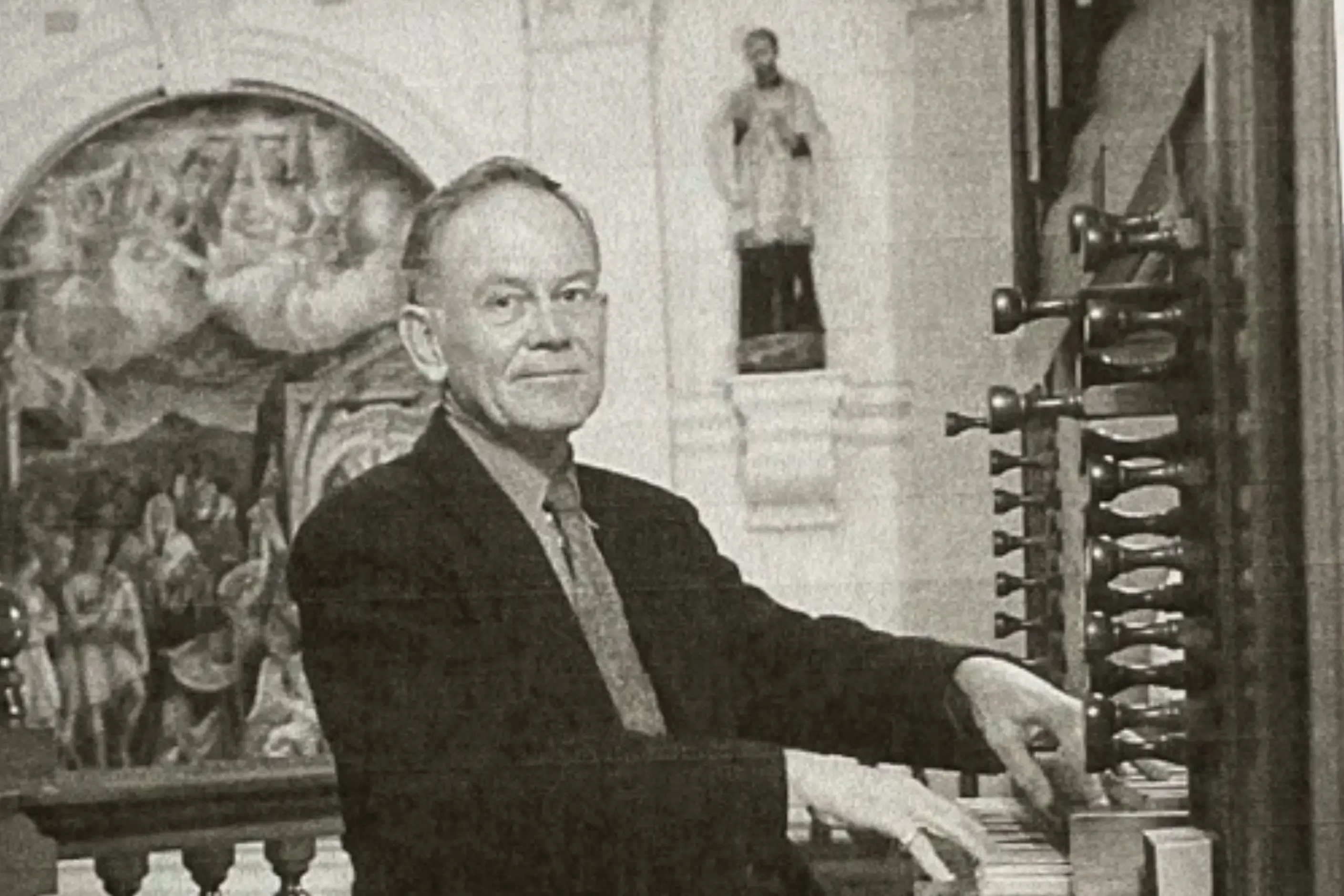
David Pentreath Kinsela, who died in Sydney on June 16 aged 85, spent his life pursuing a simple question: how did the great composers intend their music to be heard?
The search took him from Young to Switzerland, England and concert halls across Australia and Europe.
It made him an internationally respected organist, harpsichordist, scholar, teacher, researcher, publisher and consultant on the conservation of historic pipe organs.
Yet despite a career that reached far beyond Australia, Young remained at the heart of his story.
Born in Sydney on June 3, 1941, David moved to Young with his family when he was six after his father, Lewis Kinsela, established a dental practice opposite the town's post office. He attended Young High School, where his remarkable academic ability earned one of the highest Leaving Certificate results the school had seen.
"He had one of those amazing brains," Peter said.
Following his father's strong advice, David first completed degrees in civil and traffic engineering and briefly worked for the New South Wales Department of Main Roads.
It was a sensible career.
But it was never going to be enough.
Music had already claimed him.
In 1967 David became the first Australian admitted to the prestigious Schola Cantorum Basiliensis in Basel, Switzerland, one of the world's leading centres for the study of early music.
He went there with a purpose.
He wanted to understand not only how to play Bach's music, but how Bach himself expected it to be played.
That pursuit became the work of a lifetime.
David immersed himself in centuries-old keyboard techniques, historical fingering, ornamentation and performance practice.
Five years in Switzerland were followed by another five in England, where he taught, researched in the British Library and continued exploring the music that had fascinated him since childhood.
Years later he reflected simply: "Above all, I wanted to learn to play the organ the way Bach did. It took me ten years."
When David returned to Australia in 1977, he brought home knowledge few musicians possessed.
Over the following decades he became one of Australia's leading authorities on early keyboard performance and historic organs.
He lectured in harpsichord at the NSW State Conservatorium of Music, advised on the restoration of historic instruments across the country, published internationally respected research, edited Bach publications, produced radio documentaries, commissioned new works by Australia's leading composers and helped preserve some of the nation's most significant pipe organs.
His performances earned international acclaim.
Critics described his Bach interpretations as "electrifying", praising their clarity, scholarship and emotional depth.
Others regarded him as one of Australia's finest organists.
But for all those achievements, perhaps David's greatest gift to Young wasn't a performance.
It was an idea.
In 1979 he founded the Festival of Early Music at Lambing Flat.
For three remarkable festivals, held in 1979, 1980 and 1982, Young became an unlikely meeting place for some of Australia's finest performers, teachers and scholars of early music. Concerts, lectures and performances introduced local audiences to music and performance traditions rarely experienced outside Australia's major cities.
Supported by the Australia Council and the NSW Premier’s Department, the festival established Young as a national meeting place for performers, students and audiences interested in early music.
David could easily have established the festival in Sydney.
Instead, he brought it home.
"I thought this was the sort of place it would be nice to enliven with man-made beauty," he wrote.
In the inaugural festival programme he explained the philosophy that guided his life's work.
"We need art if we are to survive as a nation."
Those words were more than a slogan.
St John’s Anglican Church in Young remained woven through David’s life. He helped secure a replacement pipe organ after the original instrument was damaged during renovations, and returned in 1987 with soprano Jeannie Kelso for a fundraising recital supporting the church’s restoration appeal.
The church where he had once waited patiently for permission to play had become the place where he chose to give something back.
Away from the concert stage David was a man who delighted in beautiful things — books, historic keyboard instruments, gardens and music. His Sydney home housed several keyboard instruments, while a fern garden became one of his favourite retreats.
In 1994 he met Herman while buying a gold string for his harpsichord.
The meeting became a lifelong partnership.
"We had a wonderful life together," Herman wrote after David's death.
Peter still struggles to describe what it was like watching his brother perform.
"To watch someone with his expertise play... it was mesmerising," he said.
He also believes David deserves to be remembered.
"To have that sort of brain... I think recognition is important."
Recognition was never something David appeared to seek for himself.
Instead, he devoted his life to understanding music more deeply, preserving Australia's musical heritage and sharing that knowledge with others.
His recordings remain.
His research remains.
The historic organs he helped save remain.
But perhaps his greatest legacy is the reminder that remarkable things can begin in ordinary places.
The boy who first waited patiently for permission to play the organ at St John's Anglican Church in Young carried that music to the world.
Then he brought a little of the world back home.