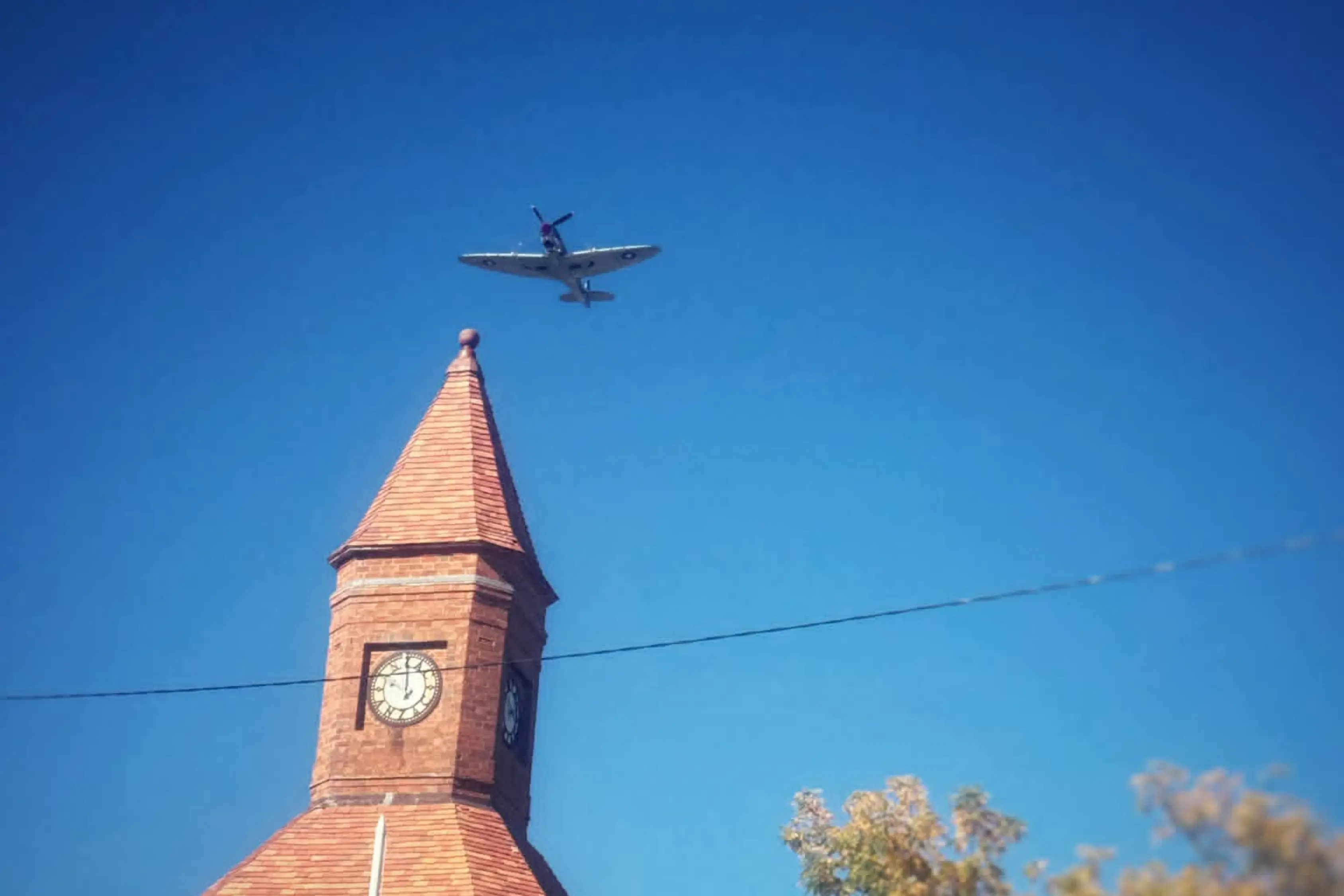
The unmistakable roar of a WWII-era Spitfire swept over Boorowa on ANZAC Day, drawing eyes skyward as part of a coordinated flyover connecting communities across southern New South Wales.

Timed to pass along Marsden Street at 9.50am, the aircraft cut through the morning stillness, adding a powerful aerial dimension to the day’s commemorations.

The flyover also passed over Harden later in the morning, with both towns forming part of a two-hour route stretching across the region from Temora through to Wagga and beyond.

Operated by the Temora Aviation Museum as part of the Royal Australian Air Force’s Temora Historic Flight, the Supermarine Spitfire Mk VIII carries a deep connection to Australia’s wartime history.

Built in England in 1944, the aircraft was delivered to Australia in April 1945 as World War II drew to a close. While it was not required for active service, it later served as an instructional airframe before being restored to flying condition in 1985.

More than 20,000 Spitfires were built, with 1,652 of the Mk VIII variant produced. The aircraft now flies in the green and grey camouflage worn by Royal Australian Air Force aircraft defending Darwin and operating in the South West Pacific, bearing the markings of Wing Commander R.H. “Bobby” Gibbes.

One of only three flying Spitfires in Australia — two of which are part of the Temora Historic Flight — its appearance across multiple towns added a striking link between past and present.

In Boorowa, the moment was felt as much as it was seen. Residents described the flyover as “thrilling,” with many noting the impact of seeing the historic aircraft pass over the War Memorial. Others reflected on the pride of small towns coming together to make moments like this happen.

The flyover formed part of a broader ANZAC Day tribute coordinated by Temora Aviation Museum and the Royal Australian Air Force’s No. 100 Squadron, with communities along the flight path pausing as the aircraft moved from town to town.

Information shared by the museum indicates that flyovers such as these are arranged through requests submitted by local RSL branches via the Australian Defence Force, offering insight into how communities can be included in future commemorations.

As the Spitfire continued its journey across the region, it carried more than history — creating a shared moment of reflection across towns separated by distance, but united under the same sky during this year’s ANZAC Day commemorations.