PHOTO
75496.0
The first general meeting of shareholders of the Burrangong Gold Dredging and Sluicing Company was held at the company’s office at 93 Pitt St, Sydney on Thursday, 17 August 1899. W. C. Coulter, Travers Jones, James Cereel Rankin, J. B. Bassetti and George A. Cranfield were elected as directors.
The company purchased the following dredging machinery: a plant-barge of 40 x 50, 300 i.h.p. engine with boiler, electric light, 12 in. Jennings’ pump and joint nozzle for sluicing purposes. The company also purchased from the Clyde Engineering Company, the Jennings’ pump exhibited at the Agricultural Society’s recent exhibition, as it was the first pump of its kind constructed in the colony.
There was some delay in starting due to necessary timber needing to be imported from the USA. However, by April 1900 the company started its operations ‘about a mile from the bridge on the Temora road, and in a bold bend in the creek’.
The company excavated ‘a tank of about half an acre in extent and 8 feet deep, upon which the dredge will float until brought to its bearings by weight of machinery’ which is when pumping and sluicing commenced. About a dozen men were employed under Travers Jones to erect sheds and workshops.
Work on the claim was 24 hours a day with three shifts required for each plant, utilising the labour of about 50 men.
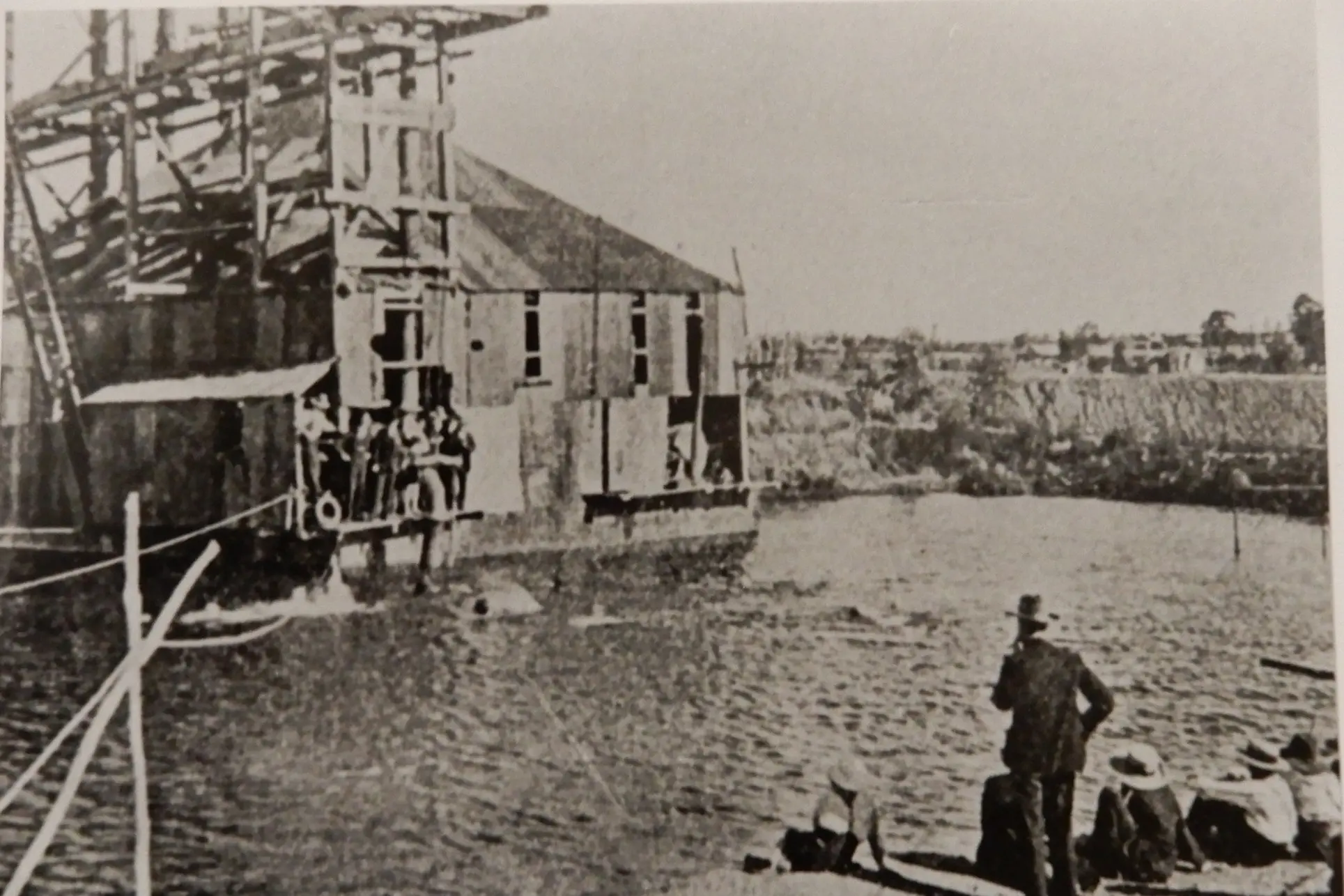
The 70 ton dredge, measuring 40ft x 45 ft and pictured with this article, was launched on 22 September 1900. It carried 100 tons of machinery and processed 120 yards of dirt per hour. Its launch was attended by the Premier Sir William Lyne, and some members of Parliament as well as a large audience of the general public. Mrs Allen Campbell christened the barge ‘The Burrangong’.
On Wednesday 20 April 1904 at about 9pm, hundreds of tons of earth fell into a drive which had become connected with a large dam, filling the shaft with water up to the level of the creek. ‘The fall could be heard a quarter of a mile away.’
While this was first reported as an accident, the manager of the mine, James Rankin later stated to the Sydney Morning Herald that ‘they sank a shaft and put in a drive for the purpose of locating the position of the main lead, which they were able to do’ and ‘upon obtaining some samples of wash the miners came to the surface and remained there waiting for the drift to come in, which it did in about half an hour.’
However, by May 1906 Rankin was declared bankrupt a second time by which time the company was wound up.