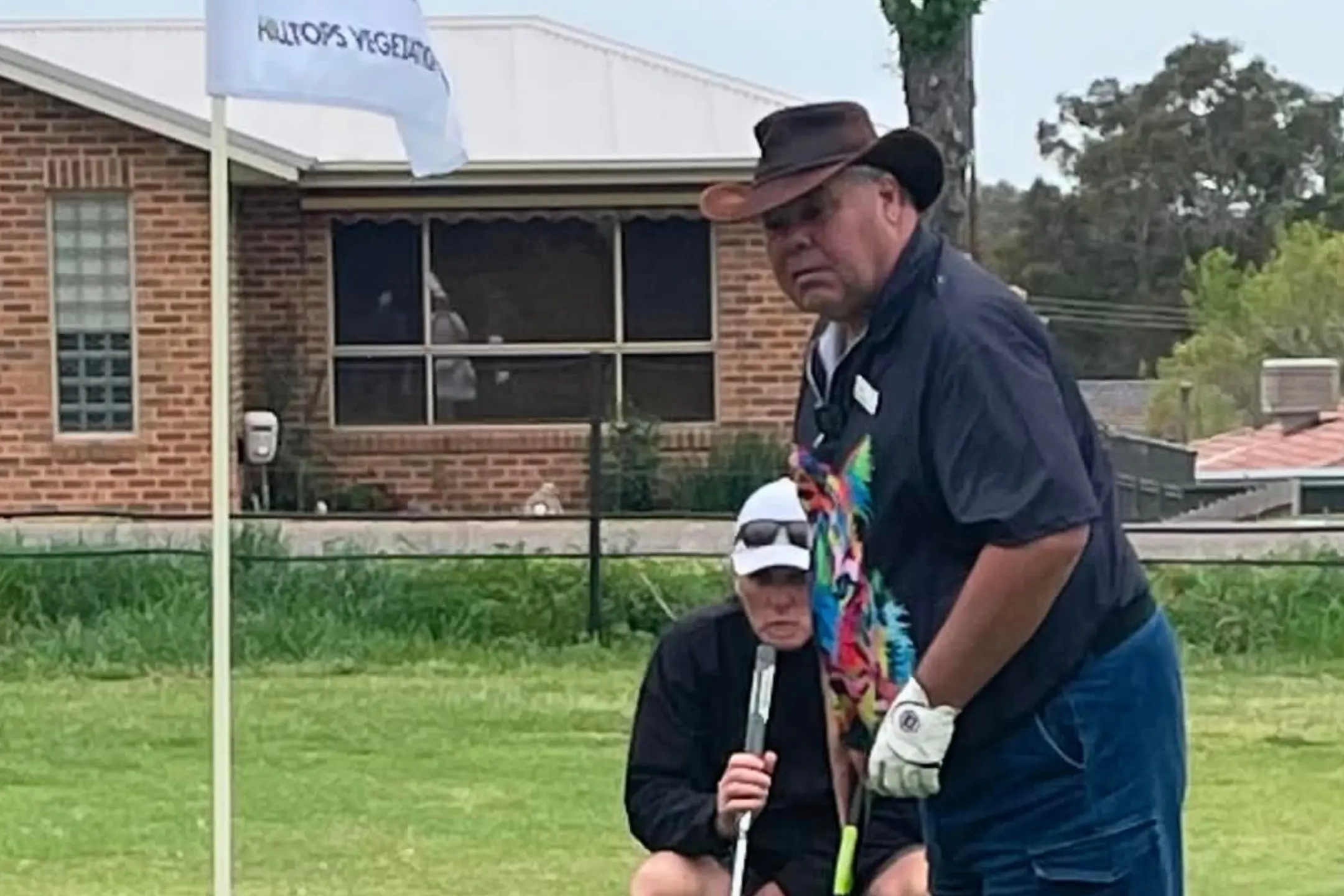
Tony Telfer has never believed in waiting for someone else to open a door.

“If you want to do something, kick it down,” he said.

It is a philosophy that took the blind sportsman from a small group trying goalball in Victoria to world championships and the 1988 Seoul Paralympic Games—and later into coaching, broadcasting and renewed competition through blind golf.

Many people in Young may know Tony’s voice before they know the full extent of his sporting history. Moving to the town in 2017, he now volunteers with community radio station 2YYY, presenting the Mystery Bag Breakfast Show on Saturday and Sunday mornings and The Sunday Lounge on Sunday afternoons.

He is also a regular at Young Golf Club, where a recent run of strong results has added another chapter to a sporting life spanning more than four decades.

In March, Tony and caddie Jeff Regan travelled to Rosebud Country Club for four days of blind golf competition.

Tony recorded rounds of 43 and 37 Stableford points in the Blind Golf Victoria Masters, finishing runner-up overall on countback.

73083.0
73083.0
Tony Telfer, second from right, with caddie Jeff Regan, second from left, after Tony’s overall victory at the Blind Golf Victoria Championship at Rosebud.

Two days later, rounds of 40 and 35 points gave him a total of 75 and the overall Blind Golf Victoria Championship title.

Tony said it was some of the most consistent golf he had played in several years.

“I’ve had some good results, but scoring-wise, that’s probably the best I’ve done,” he said.

The result followed local recognition earlier this year, when Tony was named the 2025 Veteran Sportsperson winner at the Young Sports Awards held at Young Services Club.

Tony began playing blind golf around 2015, before moving to Young, but said he became more serious about the sport after settling in the region.

He now plays regularly with Jeff, who assists with direction, club position and locating the ball.

“Without him, I couldn’t play,” Tony said.

Tony approaches each round with a straightforward goal.

“When I go out there to play golf, I only ever go out there to try and beat the course,” he said.

“If the results come, then they come.”

Long before golf, Tony’s sporting life had already taken him to the highest level.

He began playing blind cricket at about 12 or 13 and was around 17 when he and several others were invited to try a new sport called goalball.

“They said, ‘We want to try this new sport called goalball,’ and wanted to get some people to come and try it,” Tony said.

“So we went up and tried it and thought, ‘Yeah, this is better than cricket.’” he chuckled

There were only about half a dozen players at the beginning.

From that small group grew a local Victorian competition, state representation and eventually an international career.

Tony made more than 25 state appearances across Victoria and New South Wales and represented Australia at the 1986 Goalball World Championships in the Netherlands, the 1988 Seoul Paralympic Games and the 1990 World Championships in Canada.

Goalball is a team sport created specifically for athletes with vision impairment.

Teams of three wear eyeshades and track a rubber ball containing bells. Players throw it towards the opposition’s goal before diving across the court to defend their own goal.

Tony said the game provided the physical contact and intensity he had been unable to access through mainstream sports.

“You get that physical contact and you get the aggression, and you get to compete at the top level in your sport,” he said.

One of Tony’s clearest memories came with his first throw in international goalball.

Before the match, he had been warned about an opposing centre player regarded as the best in the world.

“My first throw in international goalball, I scored directly through him,” Tony said.

“That’s one main thing that I remember.”

Reaching international competition in the 1980s required more than sporting ability.

Tony said his overseas campaigns were self-funded, with little of the financial assistance now available to elite athletes.

He worked for the Victorian Ambulance Service at the time, and his colleagues raised money to help him represent Australia.

“If it wasn’t for those people, I wouldn’t have been able to get over there,” he said.

Australian teams also had limited opportunities to compete internationally before major tournaments.

Tony said the difference became clear when they met athletes from countries with far greater international experience.

Australia did not win many games, but he said the team learned a great deal and was able to demonstrate that disability sport belonged on the world stage.

“One of the big things was to showcase your ability to the world and show that, despite disability, the sports are as engaging and enthralling as any other competition,” he said.

Tony played goalball until 2010, later coached at state level and coached New Zealand from 2011 to 2013.

He was also inducted into Goalball Australia’s Hall of Fame.

But his contribution to disability sport did not end when he stopped competing in goalball.

Years later, Tony and several friends were sitting in a pub discussing the lack of accessible coverage of international tournaments.

Video footage was sometimes available, but without commentary it offered little to blind audiences.

“What coverage there was, they would put on a video of it,” Tony said.

“That’s pointless.”

The conversation led to the creation of Disability Sports Network, an internet radio and television service covering blind football, blind cricket, goalball and issues affecting people with disability.

Tony travelled to Finland, Canada and the United States to commentate on international competitions.

He said seeing goalball later receive mainstream Paralympic coverage was one of the most satisfying outcomes of that work.

That same willingness to participate was encouraged from an early age.

Tony came from a family of 10 children, began working at 15 and qualified as a saddlemaker.

He said he was taught that impaired vision might require him to approach some things differently, but should not become a reason not to try.

“It hasn’t stopped me from doing anything that I want to do,” he said.

Tony now wants to create more sporting and social opportunities for people with disability in the Hilltops region.

An Interstate Blind Golf Challenge is being planned for Young from October 25 to 27, with blind golfers from New South Wales and Victoria expected to attend.

Tony hopes local people with disability will attend on the Sunday afternoon and try golf for themselves.

He said regional communities often offered fewer sporting and recreational opportunities than metropolitan areas.

His goal is not simply to find the next competitive golfer. He wants to create opportunities for people with a disability to become active, meet others and feel part of their community.

“If we get one person with disability attending, then that to me is a win,” Tony said.

“We’ve got to start somewhere.”

Tony knows how far one small beginning can lead.

His own journey began when half a dozen players agreed to try a sport they had barely heard of.

Now, from Young, he is working to create the same first opportunity for someone else.