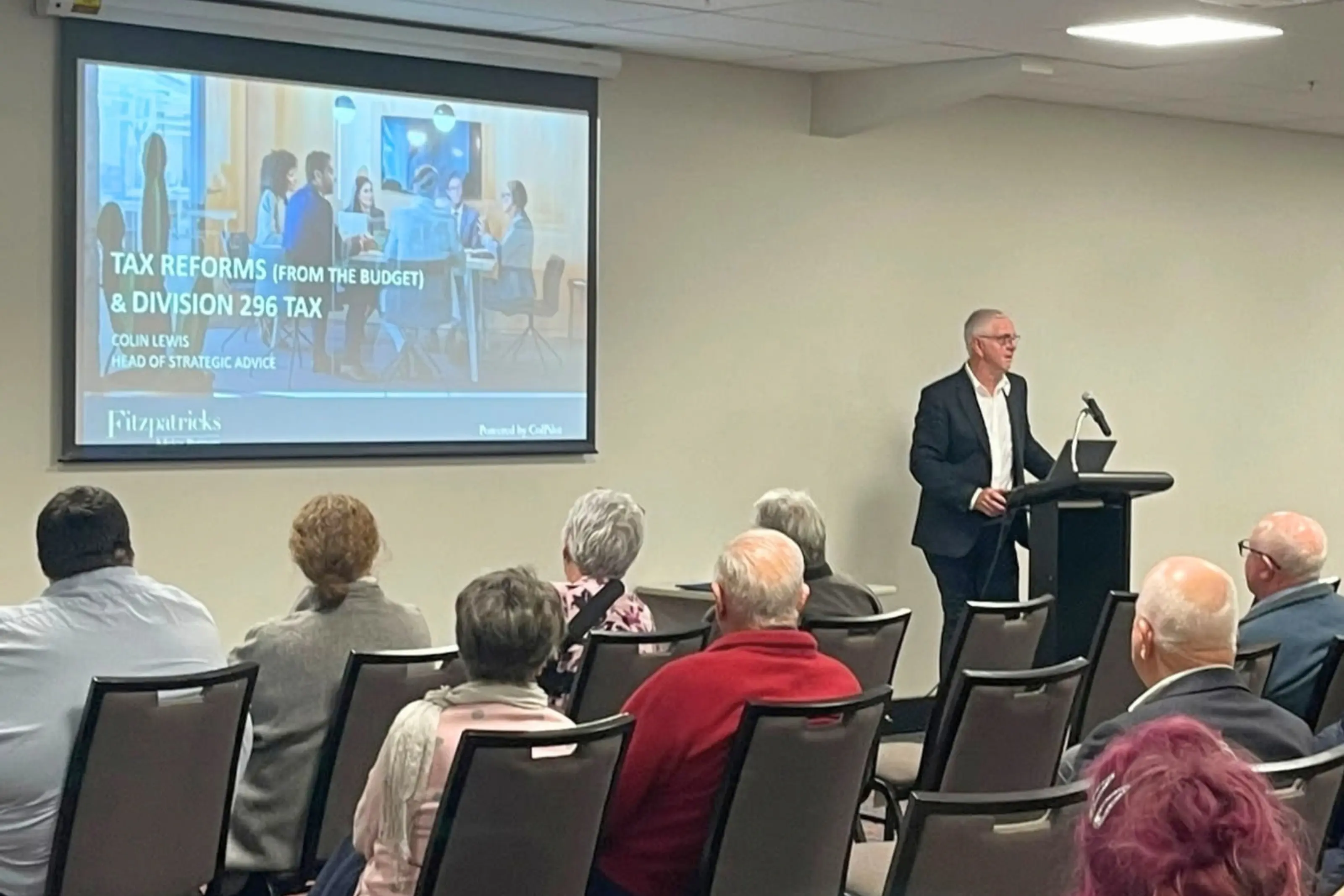
Legislation introducing a 30 per cent minimum tax on discretionary trusts has now been introduced to Federal Parliament, bringing changes discussed at a recent FTS Financial Planning seminar in Young into sharper focus. Family businesses and people using discretionary trusts are being encouraged to understand the proposed tax changes, which could alter how trust income is distributed from July 2028. Financial planning strategist Colin Lewis outlined the changes during an FTS Financial Planning Federal Budget seminar in Young, describing discretionary trusts as one of the more significant areas still being worked through. Under the legislation now before Parliament, trustees of discretionary trusts would pay a minimum tax of 30 per cent on taxable trust income from July 1, 2028. The measure is not yet law. Mr Lewis said one of the important points for people to understand was that the proposed 30 per cent minimum was not the same as simply being in a 30 per cent marginal tax bracket. “The discretionary trust tax is a big thing,” he said. “I’ve had so many people say, ‘Oh, but I’m already paying 30 per cent. I’m in the 30 per cent tax bracket.’ And you go, that’s not what it’s about.” Under the proposed model, the trustee would pay the minimum tax before income is distributed. Beneficiaries would still declare their share of trust income, while non-corporate beneficiaries would receive a non-refundable tax offset for the tax already paid by the trustee. Where that offset exceeds the beneficiary’s own tax liability, the excess would not be refunded and would be lost. Only beneficiaries with enough income to absorb the full tax offset would be unaffected, with Mr Lewis putting that level of income at around $230,000. “It also means that corporate beneficiaries, commonly known as bucket companies, will be dead,” Mr Lewis said. Mr Lewis said this meant the impact could be quite different for lower and middle-income beneficiaries than people might first assume. The reforms are particularly relevant to family businesses because discretionary trusts are often used for reasons extending beyond tax, including succession planning, flexibility and asset protection. The government has proposed a number of exclusions, including testamentary trusts, charitable trusts, special disability trusts and superannuation funds. Primary production income, including farming income, is also proposed to be exempt from the minimum tax. That does not necessarily mean farming families can ignore the reforms. Mr Lewis said many farming and family business structures use discretionary trusts for a range of purposes, and the impact would depend on the type of income involved and how the trust is structured. A significant change would allow existing discretionary trusts to elect to make fixed distributions to pre-nominated beneficiaries and, in return, be exempt from the proposed minimum tax. Mr Lewis described the proposed arrangement as effectively making a discretionary trust behave more like a fixed trust for tax purposes without requiring the trust itself to be restructured. He jokingly referred to it during the seminar as a “Clayton’s trust: the trust you have when you’re not having a fixed trust” — a trust that remains discretionary in form while fixing beneficiary entitlements for tax purposes. The trade-off, he said, would be flexibility. One of the reasons families and businesses use discretionary trusts is the ability to vary distributions between beneficiaries from year to year. Under the proposed election, those entitlements would instead be fixed. Mr Lewis said that could be difficult for businesses where income varies considerably from year to year. “You’re giving up that flexibility to make your discretionary trust look like a fixed trust going forward,” he said. The Government says the fixed-distribution election is intended to give existing trusts another option without requiring a restructure. It has also proposed three years of rollover relief from July 1, 2027 for businesses and others who choose to restructure. Mr Lewis cautioned people against making changes before the final legislation is settled. “The devil is always in the detail,” he said. His message for people who may be affected was to understand what is being proposed and seek professional guidance about their own structure rather than act on the headline tax rate alone. The legislation is now before federal parliament and is not yet law. This is the third in a four-part series following FTS Financial Planning’s Federal Budget seminar in Young. The Young Witness is breaking down the major changes Colin Lewis outlined into smaller, easier-to-understand sections. The final article will look at Division 296 superannuation tax. This article is general information only and is not intended as financial, tax or legal advice. Readers should seek professional advice for their individual circumstances.