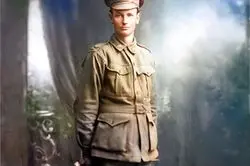
Private Walter Jenkins MaloneBoorowa War Memorial Private Thomas Harold ProsserBoorowa War Memorial In the closing months of World War I, the Australian Corps under Lieutenant General Sir John Monash played a central role in breaking the Hindenburg Line, the last great German defensive system on the Western Front. Between 29 September and 5 October 1918, Australian divisions fought through the Battle of St Quentin Canal and the Battle of Montbrehain, the final infantry action fought by Australian troops in the war, helping force the collapse that led to the armistice five weeks later. Boorowa's own war record runs alongside that campaign rather than through it. Six men from Boorowa and Frogmore served with the same unit, the 19th Battalion, Australian Imperial Force (AIF), part of the 5th Brigade, 2nd Division. By the time their battalion reached the Hindenburg Line's final defences in October 1918, none of the six remained with it. Their stories, pieced together from Virtual War Memorial Australia records and, for one man, his full National Archives service file, tell a harder truth about the district's war: five of the six never came home. Privates Walter Jenkin Malone, Thomas Harold Prosser and William Abraham Roberts, of Frogmore, enlisted within weeks of each other in mid-1916 and embarked together from Sydney aboard HMAT Ascanius on 25 October 1916, alongside Boorowa-born Private Harold Ernest Harrigan. All four were initially posted to the 56th Battalion before transferring into the 19th Battalion in early 1917, alongside Private John Henry Wesley, whose consecutive service number places him in the same reinforcement draft. Prosser was the first to fall, killed in action at Bullecourt on 3 May 1917. Harrigan, who had earlier been gassed and returned to duty, was killed on 8 August 1918. Roberts died three days later, on 11 August, and has no known grave; he is commemorated on the Villers-Bretonneux Memorial. Malone was killed on 31 August 1918, the same day Wesley was wounded in the same battle, the Australian victory at Mont St Quentin, near Péronne. Wesley survived a severe gunshot wound to the ankle and knee, was evacuated through France to hospitals in England, and spent the remainder of the war recovering in Bristol, London and Dartford. He was awarded the Military Medal for his part in the fighting at Mont St Quentin. It was that wound, and the months of hospital treatment that followed, that meant Wesley, like the rest of his Boorowa cohort, was not present when his old battalion later fought its way through the Hindenburg Line's Beaurevoir Line defences at Estrées, in early October 1918. A sixth Boorowa man, Private William Henry Edgeworth, had joined the 19th Battalion even earlier, embarking in August 1915. He was later transferred to the 18th Battalion and was killed at Third Ypres, in Belgium, on 20 September 1917, more than a year before the Hindenburg Line fighting. He is commemorated on the Menin Gate. Between them, the six men's service spans almost the entire length of the war, from 1915 reinforcement drafts through to its final weeks, a reminder that a small district's part in a famous campaign is rarely as simple as one battle or one name on a memorial. Private William Abraham RobertsVirtual War Memorial Australia Private Harold Ernest HarriganVirtual War Memorial Australia