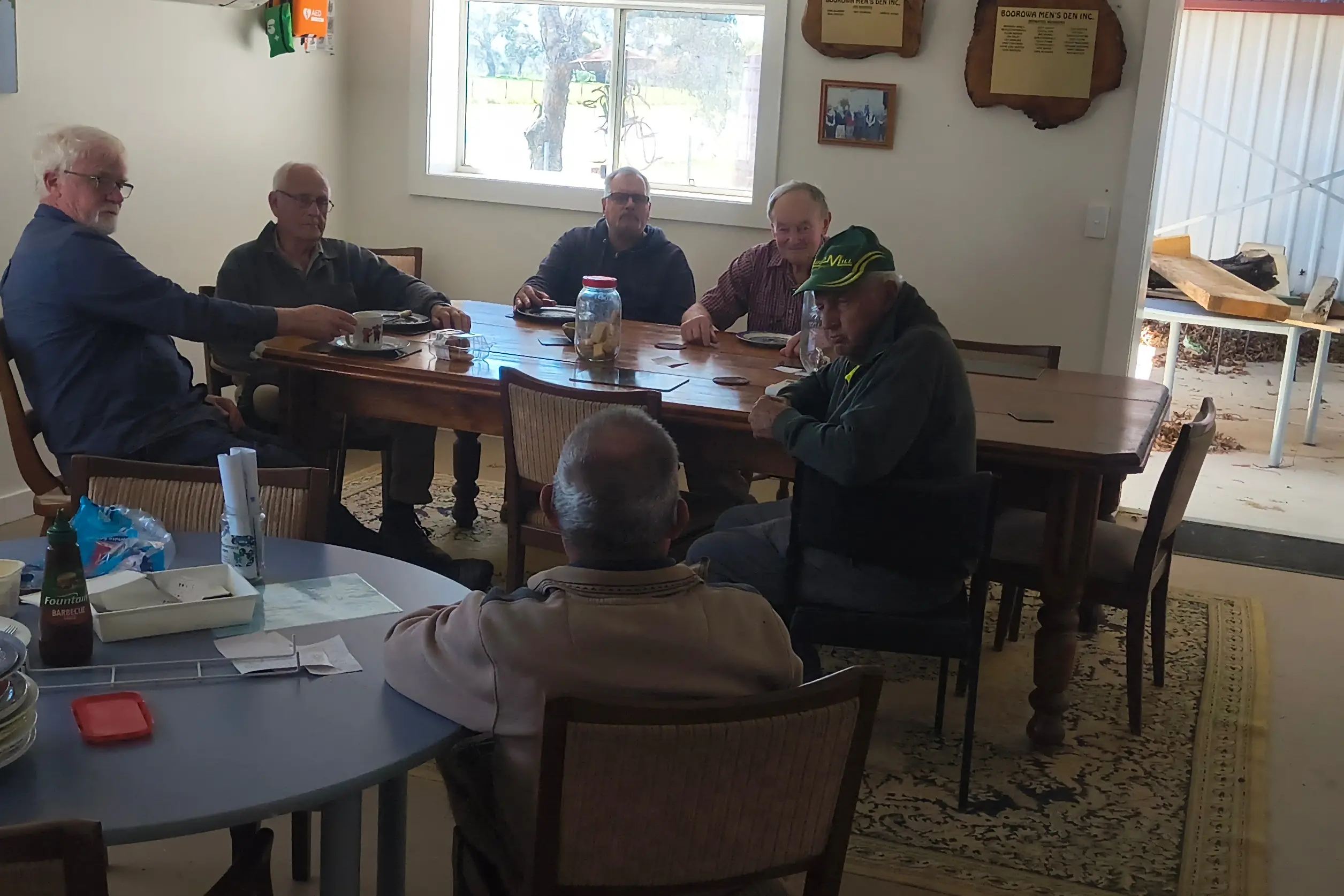
Last week I stepped outside this series to write about men standing up against domestic violence, and holding each other to account. This week I'm back on rural mental health, looking at another way blokes can look out for each other: the support that happens long before anyone sees a professional, and usually without anyone calling it support at all. The Australian Men's Shed Association (AMSA) has a line every bloke in the bush will recognise: men don't talk face to face, they talk shoulder to shoulder. Sit most country men down across a table, ask how they're really going, and you'll get "yeah, good". Put them side by side at a workbench, or leaning on the tray of a ute, and the conversation goes somewhere else entirely. Nobody has to make eye contact. Nobody has to call it a chat. The work keeps your hands busy while the real stuff comes out sideways. That's what a Men's Shed does, and there are now more than 1300 of them across Australia, with more than 60,000 men involved, and Boorowa has its own. The Boorowa Men's Den meets at the Showground on Wednesdays and Thursdays from 9am to noon. It started in about 2005, and it turns out woodwork, metalwork, furniture repairs and odd jobs for the town. Founding member Max Stanford first came along because he was new in town and knew no one. John Dymock joined after retiring from farm work. "You just can't sit there all the time," he said. "I think it's essential that you've got someone to talk to, and you can say whatever you like here." It's easy to write a shed off as a hobby. It's more than that. Throughout this series I've kept coming back to one idea: you can only notice someone is off if you know what their normal looks like. A shed builds that baseline without anyone trying. See the same blokes twice a week, every week, and you notice when one stops turning up, goes quiet, or starts making jokes that don't quite land. Researchers call these people gatekeepers: ordinary community members who notice someone isn't right before it becomes a crisis. A 2023 study of rural suicide prevention found this informal network is often the front line in country towns, where stigma, particularly among men, still keeps many from walking into a clinic. The evidence says gatekeepers can get better at it, too. A trial published last year in The Lancet Healthy Longevity put 261 men from 19 Men's Sheds, with an average age of about 72, through Mental Health First Aid Australia's Conversations about Suicide course. Seven months later they were more confident supporting someone at risk, held fewer stigmatising beliefs, and those who did step in gave better-quality help. That matters in a district like ours, where formal services are thin on the ground and a long drive away. The shed, the rugby club, the bowls green, the Rural Fire Service brigade, the bloke over the fence: these are where most of us will first be noticed, if we're noticed at all. Informal support isn't a replacement for professional help. It's the bridge to it. The mate who notices is often the one who drives you to the GP, or to the free walk-in Medicare Mental Health Centre at 147A Boorowa Street, Young, where you don't need a referral or even a Medicare card. So here's my ask this week. If you're retired, recently widowed, off the farm, or just finding the days long, knock on the shed door on a Wednesday or Thursday morning. You don't have to talk about anything. Just turn up and pick up a tool. And if you're already part of a shed, a club or a crew, you're better placed than any service to notice when a mate is off. Use it. Talking shoulder to shoulder still counts.