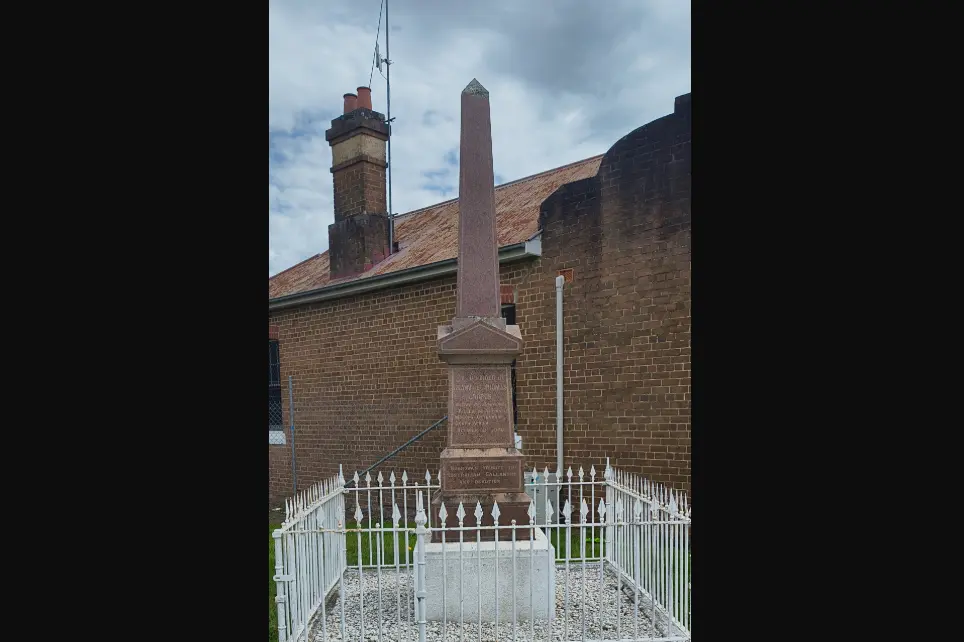
Trooper Granville CooperSupplied ON the corner of Pudman and Court Streets, beside the old Municipal Chambers, stands a red granite obelisk that has watched over Boorowa for 125 years. Stop 40 on the Shamrock Trail, it honours Trooper Granville Thomas Cooper, the first Burrowa man killed in the South African (Boer) War. One of nine children of Solomon and Charlotte Cooper, Granville was a capable horseman who volunteered in January 1900 with the New South Wales Citizens’ Bushmen. He sailed for South Africa the following month, arriving at the end of March. His contingent was ordered to relieve the besieged town of Mafeking, but the siege had lifted before they arrived. He went on to serve as a scout through Rhodesia and the Transvaal. In October 1900, his patrol was searching a farmhouse near the Molopo River for Boer rifle-repair tools when about 200 Boers surrounded them. Ordered to ride for their lives, the men scattered. Cooper’s horse was shot from under him and a bullet tore into his arm. He shot dead a Boer horseman trying to cut him off, then ran for safety. A sergeant turned back to rescue him, but a second bullet struck Cooper in the stomach, and he died within hours. General Hutton later wrote to his parents that he was well liked and respected, and one of the best men he had. Residents raised about £70 for the memorial, which was unveiled by the mayoress, Mrs Isaac Stevenson, on 12 October 1901, a year after the fatal skirmish. About 300 people braved poor weather as the Burrowa Band, led by W. O. Jenkins, marched through the streets and public school children sang patriotic songs. A former schoolmate told the crowd that returned comrades said Cooper’s only fault “was that he was too brave”. Teacher J. M. Boyle thanked the town on behalf of the Cooper family, saying their grief had been softened by the community’s sympathy. Standing 12ft 6in on a bluestone base, the obelisk bears a gold-lettered inscription calling it “Burrowa’s tribute to Australian gallantry and devotion”. Speaker John Long predicted it would stand “for generations and generations”. On Monday 12 October, it marked 125 years.