
PHOTO
66493.0
While the railway line from Murrumburrah to Young opened on 26 March 1885, the next section of track, from Young to Cowra, opened just over a year later on 24 May 1886. Tenders for this track were called for in December 1884.
The contractor for the Young to Cowra section was George Fishburn’s company, Fishburn & Co., who was the lowest of nine tenderers at £240,515. Fishburn & Co started constructing the Young to Cowra line in February 1885.
By the beginning of May, railway works were progressing rapidly; 800 men were employed and about 160,000 cubic yards had been excavated. Fishburn & Co made an agreement with Carlo Marina of Moppity, to open a ballast quarry on his Solferino Estate.
In August 1885, a journalist described ‘giant ploughs with teams of sixteen to twenty-eight oxen each, are steadily at work turning up the track, and scoops are throwing up the earth; fencers are erecting miles upon miles of posts and straining wires between them; blasting operations are proceeding apace; cuttings are being rapidly executed; piles of timber have been prepared ready for the bridges.’ By December 1885, 32 out of 50 timber bridges had been completed.
The line was opened unofficially on the Queen’s Birthday, Monday 24 May 1886, seven months before it was due.
About 700 people travelled by train from Young to Cowra and the celebrations raised funds for the new hospital at Cowra. The first train left from Young at 8.15, arriving at Cowra at 10.30. A temporary platform was made within three-quarters of a mile of the river.
The second train of 20 carriages arrived an hour later. The trains passed under a triumphal arch, upon which the word “welcome” was conspicuously shown in large characters.’
The line was formally opened for traffic on Tuesday 21 September by the contractors who supervised traffic until 1 November when the government took over the line.
Trains were run three times a week on Tuesdays, Thursdays and Sundays at 9:10 am and the fares for passengers were first class one way, 6s 9d; second class one way, 4s 9d; first class return, 9s; second class return, 6s 9d.
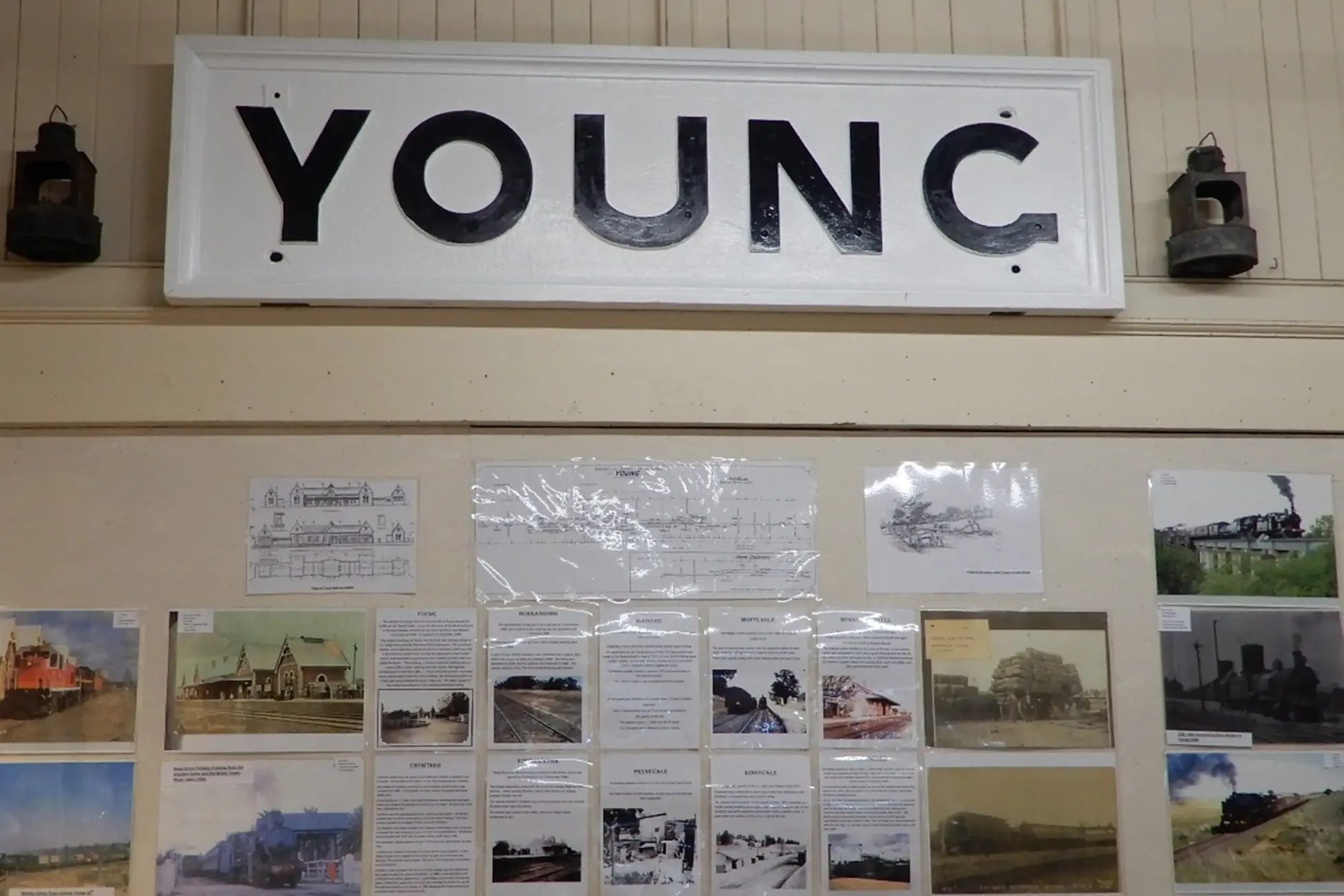
Last year, Barry Snelson donated the original Young Railway Station sign to the Museum, along with two railway signal lamp inserts from the Kingsvale Railway Station, salvaged in the 1970s.
On Saturday 9 May 2026 between 10 and 11am, please join us at the Young Historical Museum on Campbell St, for a conversation between Barry and Julia Palmer (daughter of Doug Palmer, a former NSW Railway employee at Young) about their memories of the local railways. This event is part of the National Trust’s Australian Heritage Festival.