The war against Japan lasted almost four years. It began on 7 December 1941, when Japanese forces attacked the American naval base at Pearl Harbour, and drew Australia directly into the fighting within weeks. By February 1942, Singapore had fallen and more than 15,000 Australian troops had been taken prisoner.

On 19 February 1942, Japanese aircraft bombed Darwin, killing more than 250 people and marking the first attack on Australian soil since European settlement.

Air raids on northern Australia continued for almost two years, with 97 raids recorded before the last, on Darwin, on 12 November 1943.

Australian forces went on to fight in a series of major battles across the region. The Battle of the Coral Sea, fought from 4 to 8 May 1942, halted a Japanese naval advance on Port Moresby and is regarded as a turning point in the Pacific war.

Japanese troops then attempted an overland advance on Port Moresby along the Kokoda Track, where Australian and Papuan forces fought them back between July and November 1942. At the same time, Australian troops defeated a Japanese amphibious landing at Milne Bay between 25 August and 3 September 1942, the first defeat of Japanese ground forces in the war.

Fighting continued through the Buna-Gona campaign into early 1943, and then through the broader New Guinea campaign, as Allied forces pushed along the northern coast through Lae, Finschhafen, Nadzab, Cape Gloucester, Hollandia and beyond, before Australian troops later fought in Borneo in 1945.

The war came to an end on 15 August 1945, when Japan accepted the Allied demand for unconditional surrender, following the atomic bombings of Hiroshima and Nagasaki.

Australia's Prime Minister, Ben Chifley, announced the surrender that morning, and the formal surrender was signed aboard the USS Missouri in Tokyo Bay on 2 September 1945. The 15th of August became known as Victory in the Pacific Day, or VP Day, and is commemorated across Australia each year.

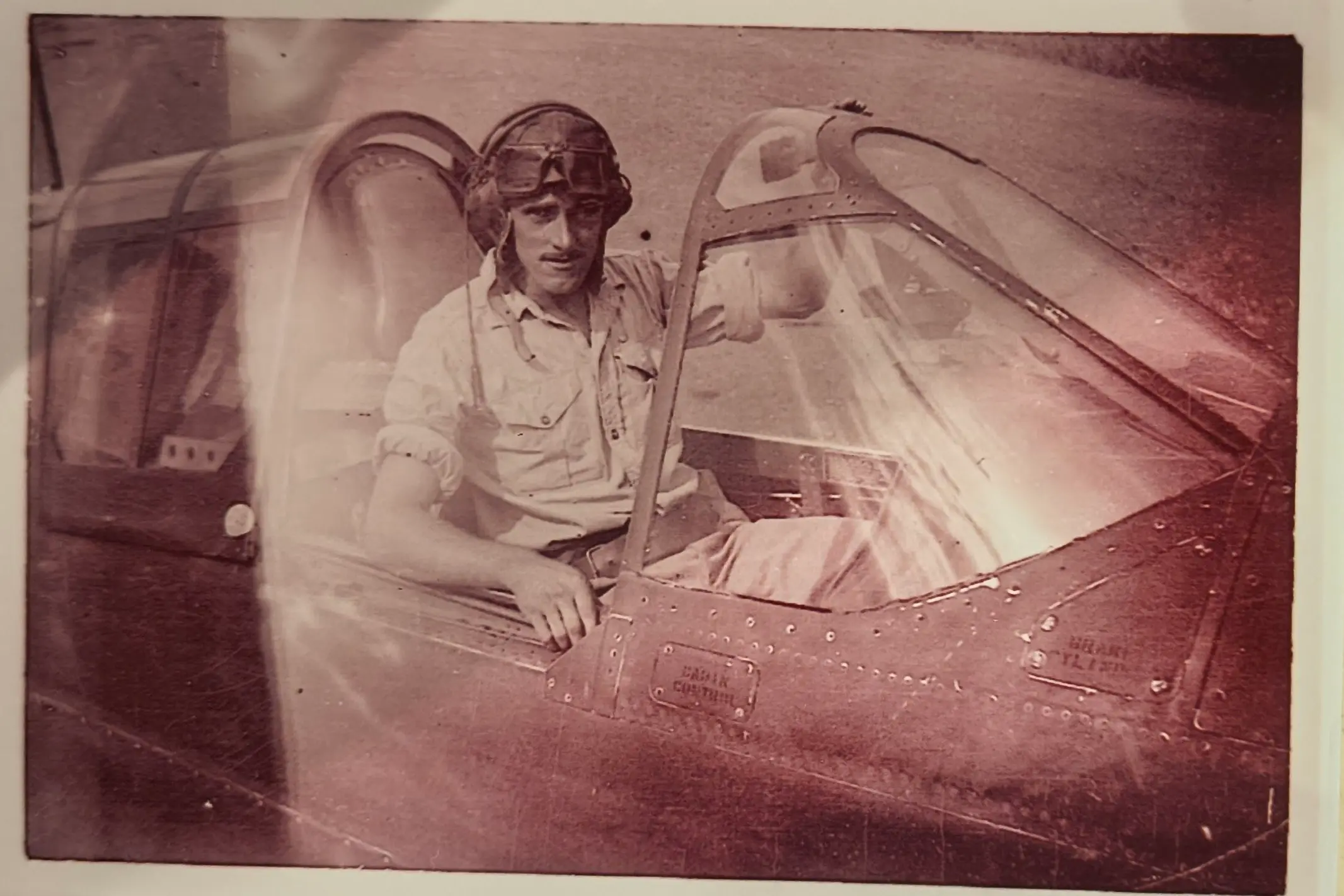
Boorowa-born Flying Officer Alf Stuart flew Kittyhawk fighters through the New Guinea campaign, and this Victory in the Pacific Day, the town remembers his service.

Flying Officer Alf Stuart's war service

Alf Stuart was born in Boorowa on 5 October 1916. He enlisted in the Royal Australian Air Force on 22 June 1941, completing initial training at 2 Initial Training School, Bradfield Park, before moving through 5 Elementary Flying Training School, 2 Service Flying Training School, 1 Wireless Air Gunners School and 2 Operational Training Unit.

He was posted to 76 Squadron at Milne Bay, New Guinea, on 3 September 1943, then transferred to 75 Squadron, also based at Milne Bay, ten days later on 13 September. Both squadrons had flown Kittyhawks in the defence of Milne Bay the year before, and by the time Stuart arrived they were flying patrols over Milne Bay and nearby Goodenough Island.

74585.0
74585.0
Flying Officer Alf Stuart I. Service Dress.

From September 1943 until the end of June 1944, Stuart flew a Curtiss P-40N Kittyhawk through the New Guinea campaign, operating from a succession of forward airstrips as the Allies pushed along the northern coast: Milne Bay, Kiriwina, Goodenough Island, Nadzab, Cape Gloucester, Tadji and Hollandia.

The moves tracked the front line itself. In the first half of 1944, 75 Squadron shifted from Nadzab to Cape Gloucester, then to Tadji and on to Hollandia, providing close air support for Australian and American ground troops and protecting Allied shipping from air attack as United States forces landed at Hollandia in April 1944.

According to his Aircrew Record of Operational Tour, Stuart flew 72 operational sorties, 15 of them strike and attack missions and 57 other operations, for a total of 176 operational hours between 7 October 1943 and 22 June 1944. He returned to Australia at the end of June 1944 and was posted back to 2 Operational Training Unit, where he remained until he discharged from the RAAF on 25 October 1945. By discharge, he had logged flying hours on Wirraways, Kittyhawks, Mustangs, Tiger Moths, Wacketts and Ansons.

Back in Boorowa, Stuart became an active member of the RSL Sub-Branch and the wider community. He has since died, but his memory lives on through his children, grandchildren and great-grandchildren.

Victory in the Pacific Day is marked each year on 15 August. It is a day set aside to remember about one million Australians who served in World War II, more than half of them overseas, including those like Flying Officer Stuart who flew, fought and served across New Guinea and the wider Pacific.

Editor's note: We believe other Boorowa locals may also have served in the Pacific campaign. If your family has a story to share, please get in touch.